


All posts by actionmentalhealth

“I’ve gained support to progress towards my entrepreneurial dream”: Maria’s story

Maria began her journey with Action Mental Health Foyle in January 2025, enrolling on the SkillSET programme with a clear ambition — to open her own skin care business. As a lone parent, she carefully prioritised her time, starting with the induction programme, where she was supported to develop a personalised training plan outlining the practical steps to turn her aspiration into reality.

Starting out with SkillSET

From the outset, Maria immersed herself in both accredited and non-accredited pre-employment training to understand employer and customer expectations, develop professional standards, and strengthen her workplace skills.

She successfully achieved her OCN Level 2 in Principles of Customer Care, completed a six-week Career Preparation course, and undertook the eight-week Biz Basics programme. Each stage of her learning was underpinned by mental health awareness training to ensure her wellbeing remained supported throughout her journey.

Becoming an entrepreneur

On 6th July, Maria proudly launched her skin care business, Ethereal Bliss, during an Action Mental Health business start-up event held in the ‘Garden of Reflection’ in L’Derry. Alongside five other clients, she embarked on her path to entrepreneurship.

Action Mental Health SkillSET client, Maria, at her business stall.

New successes

With the continued guidance of her Key Worker, Allison, Maria applied for and secured additional support to grow her business. Her determination paid off when she was selected for the prestigious AIB–TU Dublin Self-Employment Course for Persons with Disabilities — outshining 40 applicants to secure one of just 20 places, each valued at €1,250.

This fully sponsored programme covers her TU Dublin course fees and provides access to essential business development tools, including a license for specialist online software to create her business plan. She will also benefit from a dedicated Business Mentor and support from the Open Doors Initiative, offering further opportunities to expand her enterprise.

Reflecting on her experience, Maria shared:

I cannot stress enough the numerous benefits in engaging with Action Mental Health SkillSet project for enhancing employability and career prospects for people with mental ill-health. The SkillSET programme provided me with opportunities for personal and social development, built my confidence, and improved essential workplace skills. I’ve gained relevant qualifications, valuable experience, and the support needed to progress towards my entrepreneurial dream.

Read more client stories.

NI Can’t Wait

From April 2026, Northern Ireland faces a severe and unnecessary funding cliff edge for voluntary and community sector-led services – including programmes like SkillSET. Please help us protect those most in need of our support.

Illya sits at his work desk in front of his computer.

“The support I received has been crucial” : Illya’s story

Delivered across Northern Ireland by Action Mental Health, the SkillSET programme is for adults not currently in employment who are experiencing anxiety, stress, or mental ill-health. SkillSET helps individuals to shape their future by building confidence and developing new skills.

Illya, a client in our Belfast service, explains how the support he received changed his life for the better:

Illya sits at his work desk in front of his computer.

Life before SkillSET

My name is Illya, I’m a Ukrainian refugee living in Belfast, Northern Ireland. For almost 2 years I had been struggling to find employment as my disability limits my options. Unfortunately, my work coach wasn’t of a great help either.

My mental health was suffering as well, I felt stressed out over the war, was lonely and depressed. Despite all this I tried my best to find a suitable employment but it felt that every effort I made was fruitless.

I sent dozens of applications each week, filled in countless forms, visited job fairs and spoke to employers there – but barely ever heard a reply. I knew my past work experience in Ukraine was not ideal: I had many different jobs in various sectors, my employment story didn’t really reflect my skills, my CV wasn’t great.

As this wasn’t really working, I found employment as a pizza delivery driver. I knew I couldn’t hold this position for long as my health condition deteriorated. I worked there for 6 months, working hard: 6 days a week, long hours, well into the night. But I had to quit as my health took a toll.

Making progress

I started looking for possible courses, that could open doors for me. I applied for ICDL course as well as Employability course with Action Mental Health and it changed everything! As I received the ICDL certificate, I believe employers were more open to the idea of considering my application.

Then Sonia at Action Mental Health helped me with my CV and I’m convinced: whatever magic she did worked straight away! I started getting feedback from employers, though not immediately positive, but still – a result! I also went to a couple of interviews which were organised through Action Mental Health.

And then I applied for a marketing position with an accounting company called Baxterworld and I could tell – they were ready to hire me after just seeing my CV! They invited me for an interview more as a formality I think – and hired me the same day. It was exciting!

A new opportunity

It was a big change in my routine, having to wake up early, go to work, learn to do new things at work, put my already existing skills to a good use. But the confidence I’ve built up thanks to support of Action Mental Health’s programme allowed me to successfully adjust, start and more importantly continue my employment. The support I received has been crucial in that.

Additionally, my new boss, Mr. Ray Baxter and the whole team at Baxterworld were equally supportive and kind. The adjustment of getting back into employment went smooth and much easier than I expected.

I’ve also met so many wonderful people at Action Mental Health! Sonia, Suzan, Nicola, Johnny, Mathew, Jenny and others I unfortunately don’t remember the names of (sorry!). As well as all the visitors to Action Mental Health. They’re all welcoming, supportive, non-judgmental, compassionate and kind people. I’m convinced they gave me confidence to keep trying, to keep applying and eventually finding an amazing company that hired me.

I’m happy to work as a trainee marketing assistant now. I feel much happier now, more confident, successful, fulfilled.

I asked my boss for permission to mention the name of the company and he kindly offered to add his feedback of my work (embarrassing!). Here’s what he had to say:

“We had the opportunity to employ Illya as a Trainee Marketing Assistant through the JobStart scheme, and he has been with us since early November. We are very pleased with his work. He has used his initiative to find ways to promote our business and attract new clients. As someone whose first language was Russian, we were surprised and delighted that his English is as good as any local speaker.”

Ray Baxter
Director, Baxterworld Ltd, Chartered Management Accountants

I’m very happy to work with an amazing and supportive team of Baxterworld. It’s been a very long time since I had a job I enjoyed and looked forward to.

I’m very fortunate to have found Action Mental Health and I wish I had done it sooner! They’re instrumental in changing people’s lives for the better!

Read more client stories.

NI Can’t Wait

From April 2026, Northern Ireland faces a severe and unnecessary funding cliff edge for voluntary and community sector-led services – including programmes like SkillSET. Please help us protect those most in need of our support.

Sam stands by a gate wearing a hi-vis jacket, in his training placement role.

“I look forward to what each day brings”: Sam’s story

Sam’s journey with Action Mental Health Foyle began in January 2025, a moment he now describes as the first step toward reclaiming his confidence and purpose. When he enrolled on the SkillSET programme on 6 October 2025, he arrived determined to move forward, yet unsure of what the future might hold.

Sam stands by a gate wearing a hi-vis jacket, in his training placement role.

Building confidence

From day one, Sam threw himself into both accredited and non‑accredited personal development and pre‑employment training. He wanted to understand what employers expected of him, but more importantly, he wanted to rediscover his own strengths.

To build his confidence further, Sam began volunteering, tending the allotments at the Fountain Community and helping develop the gardens at St. Columb’s Park. These experiences allowed him not only to learn new skills but also to reconnect with people, nature, and a sense of community contribution.

His dedication paid off. Sam achieved two Level 2 accredited programmes, in RSPH Award in Food Safety and Hygiene and OCNNI Stress Management Techniques. Every step of the way, mental health awareness training helped him stay grounded, supported, and resilient. Sam wasn’t just gaining qualifications; he was rebuilding his life.

A new opportunity

Then, in November, an opportunity arrived that would change his trajectory. Grahams Construction, a leading company delivering major projects across the UK and Ireland, offered a paid 12‑week training placement as part of their social value commitment.

Sam was one of many to interview, but he stood out, not just for his impressive CV, but for the determination he had nurtured throughout his time on the SkillSET Programme.  He secured the placement and began on 7 November 2025.

Since starting, Sam has flourished. He has embraced the variety of tasks, the chance to learn from experienced teams, and the excitement of travelling to different sites. Reflecting on his progress, Sam shared:

“I am blown away by the opportunity and the experience. I look forward to what each day brings.”

How SkillSET helped

Sam credits the Action Mental Health SkillSET programme’s carefully designed model of delivery, led by highly trained staff with specialist expertise in mental health support, for providing the structure, guidance, and encouragement he needed to progress.

With a framework grounded in professional mental health practice, he benefited from focused goal‑setting, tailored coaching, specialist pre-employment mentoring, combined with high‑quality training that supported both his wellbeing and his personal development.

He describes the intervention as exactly what I needed at exactly the right time”, reflecting the impact of working with staff who truly understand the complexities of mental health recovery.

The next chapter

Sam now encourages anyone on their own mental health or recovery journey to connect with Action Mental Health Foyle, saying they genuinely do “take action on mental health.”

Sam knows his journey is far from finished. With renewed confidence, strengthened skills, and a belief in his future, nurtured through the support of mental‑health‑specialist staff, he feels ready to step forward and begin writing the next chapter of his life.

Read more client stories.

NI Can’t Wait

From April 2026, Northern Ireland faces a severe and unnecessary funding cliff edge for voluntary and community sector-led services – including programmes like SkillSET. Please help us protect those most in need of our support.

Client in our Lisburn service standing beside a SkillSET banner and a member of staff from Action Mental Health.

“I have regained my self-worth”: Lisburn client story

Delivered across Northern Ireland by Action Mental Health, the SkillSET programme is for adults not currently in employment who are experiencing anxiety, stress, or mental ill-health. SkillSET helps individuals to shape their future by building confidence and developing new skills.

A client from our Lisburn service, shares his experience of the programme:

Client in our Lisburn service standing beside a SkillSET banner and a member of staff from Action Mental Health.

“I used to feel like a failure, but since joining the SkillSET programme at Action Mental Health Lisburn, I have been able to access valuable support that has helped me rebuild my confidence and self-esteem.”

“The classes, particularly the stress management course, have been especially beneficial. I learned practical ways to handle stressful situations more positively, which has motivated me to take on further training and explore new opportunities.”

“Through attending the weekly Employment Hub sessions, I have now gained paid employment and, in doing so, have regained both my self-worth and my sense of identity.”

“I would wholeheartedly recommend the SkillSET programme at Action Mental Health Lisburn to anyone who may benefit from it.”

Read more client stories.

NI Can’t Wait

From April 2026, Northern Ireland faces a severe and unnecessary funding cliff edge for voluntary and community sector-led services – including programmes like SkillSET. Please help us protect those most in need of our support.

A group of 4 children laughing and smiling while sitting in a park.

Switch off, tune in: Take on our Digital Detox for Children’s Mental Health Week 2026

A teenage girl wearing headphones and scrolling on her phone.

Switch off to tune in this February as we mark Children’s Mental Health Week with a Digital Detox challenge.

Children’s Mental Health Week takes place from 9-15 February this year. Throughout the month, we’re encouraging schools and families to give up non-essential screen time. Not as a punishment, but as a way to recharge and reconnect.

What is a digital detox?

Think of it as a mini-holiday from your devices. A digital detox just means intentionally reducing or pausing screen use to give your mind a breather. That might include smartphones, tablets, computers, consoles, and social media.

Why reducing screen time matters

Phones and social media can be fun, helpful and are part of everyday life. But now more than ever, it’s important to pay attention to our digital habits and how that affects our wellbeing.

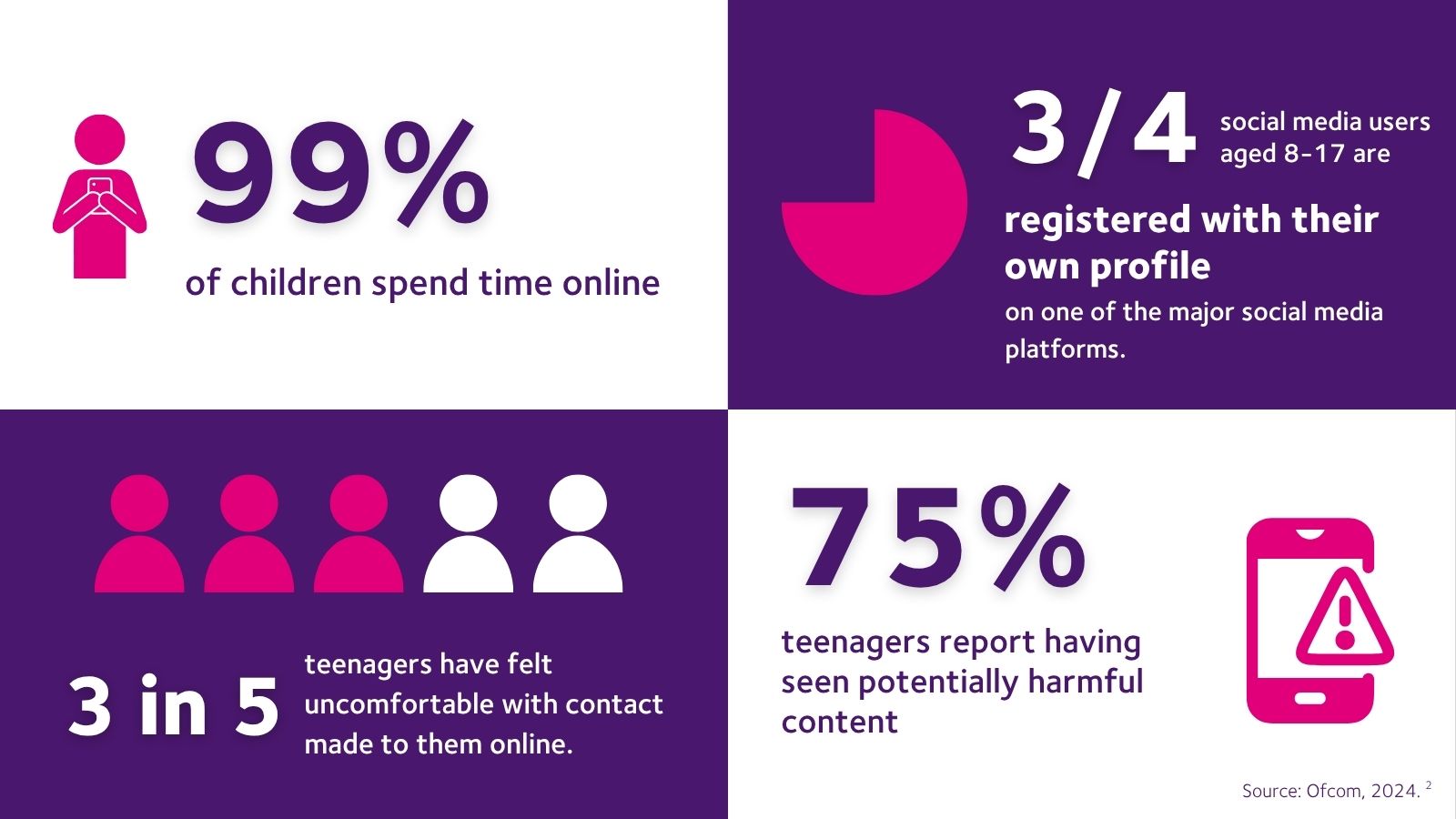
A 2023 survey showed that 45.2% of 16-year-olds in NI have probable mental ill-health. It also found that the wellbeing of 11-year-olds was at its lowest level since 2016. Getting positive comments on social media and safety online were among the causes of stress and worry noted by young people1.

Reducing screen time helps break cycles of comparison, overstimulation, and constant alerts that can contribute to stress and low mood. In their place, you create space for healthier habits which nurture your wellbeing.

A group of 4 children laughing and smiling while sitting in a park.

The feel-good benefits of a digital detox

1. Lower stress & anxiety

Stepping away from constant alerts and social feeds gives your mind a well-deserved rest, easing overload and helping restore balance.

2. Better, deeper sleep

Your brain encourages the production of a chemical called melatonin when it’s tired. The bright light behind your mobile phone screen keeps the brain alert, decreasing levels of this chemical and making it harder for you to fall asleep. So no screens means better sleep!

3. More time for the things you love

Learning new things, getting active, or connecting with others are all ways you can practise the 5 steps to wellbeing. So whether it’s relaxing with a book, playing sport, or going for coffee with a friend – less scrolling means more time for things that truly nourish wellbeing.

4. Make a real difference in your community

Being sponsored for your Digital Detox efforts is a fantastic way to raise vital funds for Action Mental Health. You’ll be helping us to support children, young people and adults with our mental health services across Northern Ireland.

4 secondary school students sitting in a classroom. They are happy and smiling together.

Ready to take on the challenge?

Make the challenge work for you this February. It could mean a detox day, no social media for a week or more! Our free fundraising pack is full of ideas to help you get started – all you need to do is register.

Get creative, get sponsored, and get ready to notice the difference. Even tiny changes can make a big impact.

For more information on Children’s Mental Health Week 2026, check out our resource library.

References

1 Mental Health Champion. ‘Factors Affecting Mental Health and Wellbeing in Children and Young People in Northern Ireland’. 25 August 2023.

A mother and young daughter reading a children's book in a library.

10 top tips for supporting children’s wellbeing

A mother and young daughter reading a children's book in a library.

Mental health in childhood is simply about how children feel, think, and cope day to day.

Just as children grow physically, their mental health develops too. With the right support and safe environments, most children learn to feel positive in themselves, build confidence, and handle life’s challenges.

Here are 10 things you can do as a parent or guardian to support your child’s wellbeing:

1. Talk about your feelings

The more we talk about how we feel, the easier and more normalised it is for children to do the same.

2. Follow a daily routine

Consistency and daily habits help children feel secure because they know what to expect from their day-to-day lives.

A father helping his son ride a bike while the rest of the family walks behind.

3. Keep them active

Getting outdoors and burning off energy will do wonders for their mood – and yours! Try a family walk, a trip to the park or even an online exercise video on the rainy days.

4. Support their interests

Your enthusiasm motivates them to explore and expand their interests. This helps children to keep learning, which is one of the 5 ways to wellbeing.

5. Encourage them to join in

Things like joining a sports club or trying something creative are great ways for children to make friends and express themselves.

A boy playing football.

6. Help to build their confidence

Every time you praise them or show you trust them, you are helping them feel valued and worthy of respect.

7. Let them know you’re there for them

Your child may not want to talk yet or feel they have the language to express their feelings. Just knowing you care and are on their side is important.

8. Use other ways of communicating

If your child struggles to express emotions verbally, you could try texting, voice notes, drawing or even emojis.

A woman looking through a school book with a young teenage girl.

9. Avoid dismissing a child’s worries

It might not seem important, but to them, it means a lot. Try to listen carefully and reassure them that it’s ok to feel that way.

10. Reassure them it’s ok to talk to others

Your child may find it easier to speak to someone else, like another family member or a school counsellor. This can sometimes be difficult for parents but the important thing is that your child feels comfortable talking to someone they trust.

Where can I get support?

If you or your child are struggling with your mental health, reaching out for help is a really positive step.

Here are some places you can find support:

  • Your GP: A doctor can give advice and connect you with the right support for your child’s needs.
  • Action Mental Health: We offer counselling for children and young people, as well as resilience-building programmes in schools and community settings.
  • Childline: Children can get support 24/7 online at childline.org.uk or by calling 0800 1111.
  • Barnardo’s: Find advice and self-help tools for a range of issues at barnardos.org.uk
  • School staff: Speak to your child’s teacher, school counsellor, or pastoral care team.

For more information, activities and tools on supporting children’s wellbeing, check out our resource library for Children’s Mental Health Week 2026.

A cafe worker reading a tablet.

Blue Monday and other myths preventing better workplace wellbeing

Each January, you may find yourself bombarded with advertisements citing that today is “the most depressing day of the year”. The term “Blue Monday” is often linked with post-Christmas exhaustion, broken resolutions and dismal weather.

Yet Blue Monday is a myth. In fact, the term was originally coined by a popular travel company as a means of selling holidays to escape the post-Christmas slump. In the years that followed, the concept quickly spread through media, yet no scientific basis has ever been established.

The reality? Mental ill-health doesn’t follow a calendar.

A group of colleagues chatting in an informal meeting.

Stress, anxiety, depression and burnout are often influenced by workload, management, culture and external pressures – not by a date in the diary. By focusing on one specific day, organisations neglect to acknowledge that workplace mental health is a year-round responsibility.

Blue Monday is a myth, yet workplace mental health is not. Here are three common myths about workplace mental health and how to move beyond them:

Myth 1: Talking about mental health will “open a can of worms”

Many organisations worry that encouraging open conversations about mental health may lead to issues that they don’t have the capacity to manage. In reality, evidence shows us that the opposite is true.

In the UK, approximately 45% of employees feel uncomfortable speaking about mental health to their manager. As a result, many individuals struggle in silence whilst mental health issues continue to escalate into crisis, long-term absence and burnout.

The Solution:

Effective communication regarding mental health must start with clear disclosure and support pathways. Employee-centred mental health policies, referral pathways and boundaries ensure that employees understand what support exists, how to access it and how their disclosure may be managed.

Action Mental Health’s Workplace Wellbeing Consultancy service has provided comprehensive, evidence-based and bespoke policy support to some of Northern Ireland’s leading employers across sectors- ensuring that frameworks exist before problems escalate.

Our “Mindful Manager” training programme ensures that policies translate to practice by equipping managers to have confident and skilled conversations about mental health within their teams.

Two warehouse workers talking to a manager.

Myth 2: Low absenteeism equates to positive wellbeing

Low sickness absence is often viewed as an indicator of low ill-health. Yet this one metric alone is never enough. In the UK, stress, anxiety and depression account for over 22 million days lost every year, with much of this cost associated with lost productivity from employees working whilst unwell.

The Solution:

Workplace wellbeing must be derived from holistic health metrics, not singular figures. Comprehensive wellbeing assessments should combine qualitative and quantitative metrics to understand otherwise hidden risks across all health domains.

Assessment tools, such as Action Mental Health’s Workplace Wellbeing Assessment, provide employers with a true representation of employees’ challenges, ensuring that wellbeing initiatives meet identified needs.

A cafe worker reading a tablet.

Myth 3: If someone is struggling, they will ask for help

Many employees don’t speak up when they’re experiencing mental ill-health. Often not because the support isn’t available, but instead due to fear, stigma or uncertainty.

For so long, mental ill-health has been seen as “taboo” in many workplaces. Employees often wonder whether asking for help will be perceived as weakness or may affect their future career opportunities.

The Solution:

Breaking the stigma surrounding workplace mental health starts with cultivating awareness. Utilise key wellbeing days, such as World Mental Health Day and Eating Disorders Awareness Week, to build a comprehensive offering of wellbeing trainings, resources and awareness events.

Not sure where to start? Action Mental Health’s Workplace Wellbeing Hub offers client organisations with a 12-month strategic activity plan, providing evidence-based interventions, trainings and resources to ensure each employee is supported 365 days a year.

Two colleagues in an office, talking and smiling.

So, if Blue Monday is a myth, what really matters?

Mental health at work isn’t about one day of the year, it’s about what happens every day after it. At Action Mental Health, we support organisations to move beyond the myths and build evidence-based and effective workplace wellbeing strategies that focus on:

  • Proactive support
  • Confident and supportive management
  • People-centred policies and frameworks
  • Resilient and supported employees

To discover how Action Mental Health can support your workplace, email [email protected] today.

Action Mental Health News & Updates

We’d love to keep you updated with news and stories from Action Mental Health and opportunities to get involved.

Sign up to our newsletter to be the first to hear about updates to services, news, opportunities and more!

Action Mental Health supports all ages in the area of mental health and emotional wellbeing through a range of activities tailored to suit group needs.

We operate across the whole of Northern Ireland. Find out more about the services here