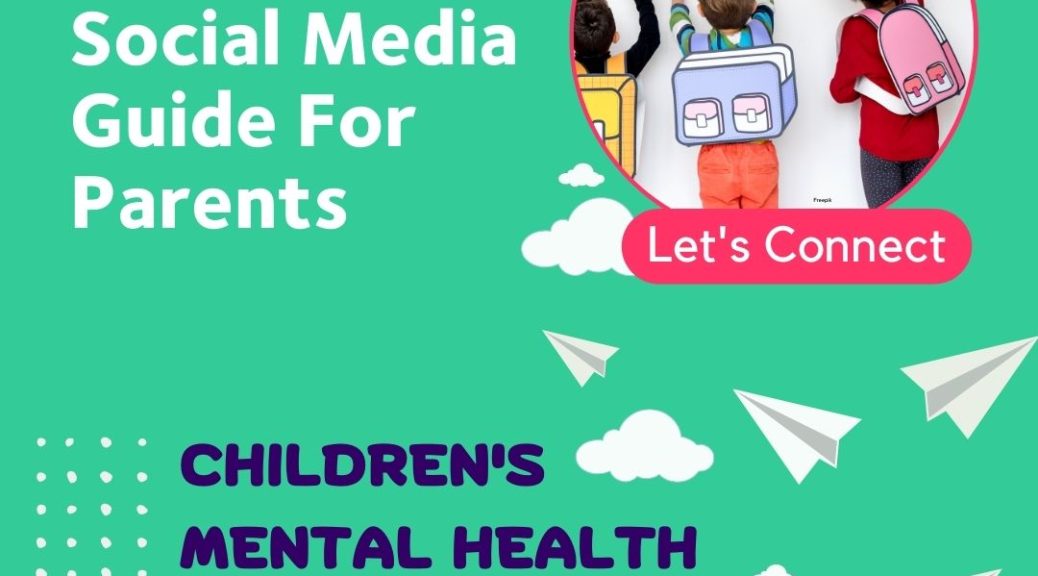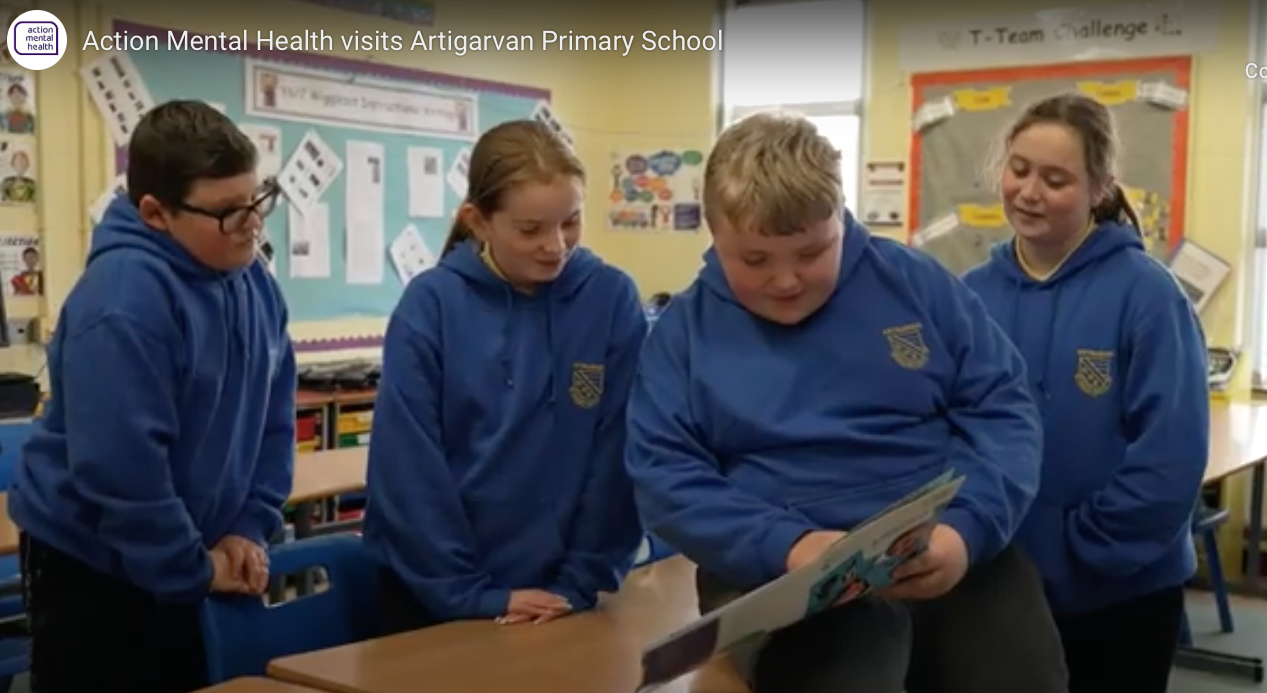

The theme for this year’s Children’s Mental Health Week 2023 is ‘Let’s Connect’ and if there is anything the last few years has taught us, it’s that humans thrive through connection and that it is absolutely vital for our wellbeing and survival.
Without these connections with others we can feel isolated and lonely which can negatively impact our mental health.
According to mentalhealth.org evidence shows that people who are more socially connected to family, friends, or their community are happier, physically healthier and enjoy longer lives with fewer mental health problems than people who are less well connected.
It’s not just the number of friends you have it’s the quality of your close relationships that matters.
Imperial College London’s Institute of Global Health Innovation brings evidence from a recent study. It showed that building good connections and having a good social connections while accessing online support, perhaps through virtual therapy sessions or peer support sites, reduced symptoms of depression in young people by as much as 26%. It’s also thought that this helps to improve anxiety and wellbeing.
The great news is it is never too early or too late to seek support and help.
Free resources for primary age and secondary age children and young people will help you take part in the week visit https://www.childrensmentalhealthweek.org.uk
If you’re interested in more information about how Action Mental Health supports children’s and young people’s mental health visit our MensSana and OUR Generation pages for more information.
Multiple world record holder and Paralympic superstar Bethany Firth OBE has become an ambassador for local charity, Action Mental Health.
The 26-year-old from Seaforde, Co. Down, who competes in the S14 classification for athletes with an intellectual impairment, clinched a gold when she was just 16 years old in the S14 100m Backstroke at London 2012 when representing Ireland.
Since then, Bethany has filled the past decade with sporting success while overcoming challenges. Swimming has changed her life, taking her to events across the world such as Funchal, Rio de Janeiro, Madeira, Montreal, and Berlin and all around the UK and Ireland.
Bethany’s winning haul includes two golds and two silvers at Tokyo Paralympics 2020. Last year she managed to take home five gold medals at the world championships, a gold in the Commonwealth Games all whilst getting married.
Commenting on becoming an ambassador with Action Mental Health, Bethany speaks candidly about her disability, which causes short-term memory loss and affects daily life:
“No matter what mental hurdles you face in sport and daily life, I think it is so important to talk about mental health within sport. When people compete at the highest level they may also be susceptible to mental health issues. I think it’s important to make people aware of this. Becoming an Action Mental Health Ambassador will help me to help others, which is something really close to my heart.”
Continuing,
“Sport completely changed me. I was shy and afraid of people knowing about my disability. My confidence increased with swimming and not just the assumed physical benefits but the great mental boost sport offers up as well.”
Action Mental Health’s Head of Communications and Fundraising, Jonathan Smyth
Welcomed Bethany into the AMH family: “We are delighted to have Bethany join us an Ambassador for Action Mental Health. Bethany has been a leading ambassador for sport in Northern Ireland for many years and is a true inspiration to many people right across the country. Bethany is also extremely passionate about promoting positive mental health and the benefits which sport and being active can bring to people of all ages. She is also very focused on highlighting the mental health challenges which people can face and the need for people to seek support when they need it. We look forward to working alongside Bethany to help raise awareness of these crucial issues.”
Bethany has a big 2023 ahead of her as she will look to use home advantage to her benefit when the Para Swimming World Championships is hosted in Manchester from 31st July-6th August.
Find out more about Bethany’s story as one of Northern Ireland’s most decorated athletes on Instagram @bethany_firth or follow Action Mental Health on @action_mental_health.
Action Mental Health client Ross Anderson, believes mental health support from the charity has given him “a future that wasn’t there”. Ross is worried its services may be cut post March 2023, when current EU funding in Northern Ireland expires.
Ross’s story, like so many others, started with severe anxiety problems, which resulted in him becoming housebound for six years. After six months with Action Mental Health the positive results were evident.
“I was at a point where I hadn’t left my house for six years, had been through different mental health services and never had that bridge to get back into society,” continuing, “Action Mental Health was the first place that I have felt that I have that foundation to get back into society.”
“It has got me introduced into socialising again and having a structure and a timetable in my life. The idea of working was something that was not on my radar but now I am in a position where it is. Now I want to go on to mental health advocacy and through them I know that is a reality, it has just given me a future that wasn’t there.”
Ross Anderson – Better times ahead.
Ross’s mum Deborah Anderson added ‘Ross has battled severe mental illness for at least 17 of his 34 years. He’s only been with Action Mental Health’s New Horizons service for a short time, however I have never seen him with so much hope for the future as he has now. This service is essential.”
Silent Saviours
Action Mental Health’s services and its support staff were “silent saviours” during the coronavirus lockdown, according to another client, Carol McGoran, who is now looking forward to returning to volunteering work after her time with the charity.
Carol McGoran – AMH were ‘Silent Saviours’ for me.
“During the Covid period, it wasn’t long that I had joined – you were completely lost but you knew at the end of the line or on a Zoom you have a key worker to encourage you and help you through your worst times.”
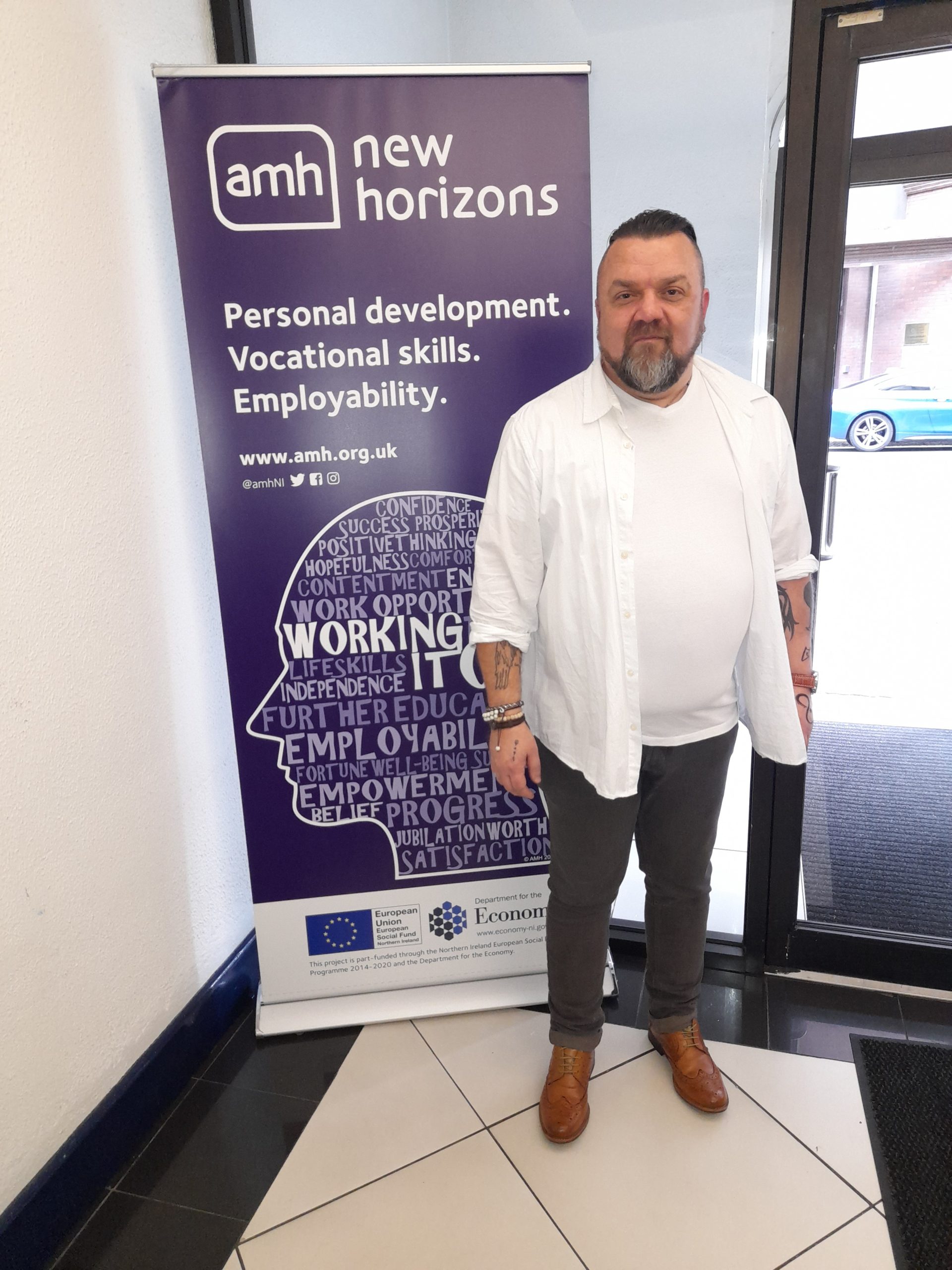
AMH New Horizons services face a very uncertain future, as ESF funding in Northern Ireland ends in March 2023. While work continues to secure new funding to continue services from April onwards, no confirmed funding is in place and time is running out.
Ross and Carol are two of the many people this vital service supports, helping them in their recovery from mental ill health and to move on to further education, work or voluntary placements. AMH New Horizons offer a direct referral route for our local health trusts and the loss or reduction in services would place unimaginable strain on already over stretched statutory mental health services.
Clients at AMH New Horizons currently take part in The “Working it Out” project which is part-funded through the Northern Ireland European Social Fund Programme 2014-2020, the Department for the Economy and the five NI Health & Social Care Trusts.
Are you ready to step up to the starting line in 2023? Action Mental Health has 3 great opportunities for you. Sign up, get active and fundraise for vital mental health services.
On 2 April take part in ‘the quirkiest’ Half Marathon around – London Landmarks Half Marathon. We only have a couple of spaces remaining. Contact us today to find out more.
Cost £35 plus platform fee. Fundraising Target £350
On 30 April be part of #TeamAMH at the Belfast City Marathon, whether you are running the whole event, being part of a relay team, doing the 8 mile walk.
Sign up for the event here and join our fundraising team here.
On 29 October how about ‘the friendliest’ marathon aka Dublin Marathon. We have limited spaces for Action Mental Health runners.
Cost £100 plus platform fee. Fundraising Target £500
If you want more information on any of these amazing opportunities or to know how to fundraise for us at your own event contact [email protected]
The Our Generation team has gathered their top tips to help you look after your mental ‘elf’ this Christmas.
While there are always things we can’t control in life, Christmas is a time to refresh mind and body and focus on the many positives. Keeping a balance is important to keep both body and mind healthy over the Christmas period and beyond.
Self-care should be our Christmas gift to ourselves this year – remembering to take regular exercise and eating a well-balanced diet can keep us fit and healthy. If you find yourself feeling lonely or isolated this festive season there are steps you can take to help yourself, so remember to turn to someone you trust if you need help.
Promoting your wellbeing at this time of year, is made easier by following The Five Ways which offer simple steps towards reducing stressful moments which may otherwise spoil this festive season.
Connect with the people around you. According to Northern Ireland’s interim Mental Health Champion, Professor Siobhan O’Neill, no matter what age we are, probably one of the most important factors for improved psychological health and well being, is relationships and connectedness with other people.
“A huge amount of research has shown the positive effects of relationships on our physical health, like blood pressure, cardiac illness, cancer, as well as our mental health, including reduced levels of stress and depression.”
If you need some time on your own this busy season, reflect; spend a while doing something you enjoy. Stay in touch with how you are feeling by connecting with your mind and body. Mindfulness is one way to do this.
Be Active. Whether you prefer walking or running, cycling, playing a game, gardening or dancing, exercise makes you feel good. Find something you enjoy and dedicate time to do it; start with 10 minutes and work up to 30 minutes of physical activity for the day.
Take Notice. Stop, pause, and take a moment to look around you right now. What can you see, smell or even taste? Look for beautiful, new, unusual or extraordinary things in your everyday life and think about how that makes you feel without judging or trying to change them. Take a few deep breaths, feel the rising and falling of your chest, and take notice of the chair under you or the weight of your feet on the floor. Try apps like Headspace or Calm for guided meditations, and you’ll learn how to notice and release tension you didn’t even realise you were carrying. Sit in your garden or go for walks with those in your live, notice nature and the sound of life.
Keep Learning. Variety is the spice of life so keep learning new things, it will make you feel more confident, will boost your self-esteem and improve your overall well being. Use any spare time to unwind, learn a skill you were putting off – cook, study a new language, exercise or get stuck into that novel. Or why not try your hand at gardening – a pastime much reported as being beneficial for well being.
Give. Look outward as well as inward. Linking yourself and your happiness to the wider community can be incredibly rewarding and will create connections with the people around you, even if you can’t physically be there. Giving can be something as simple as using social media in a positive way to share messages or support. Make a call or send a text to a friend, older relative or someone living on their own – it might just make their day to know that someone is thinking of them.
Lastly, give yourself a hug. You can only do so much and you’re doing the best you can. Try to love yourself – you can’t pour from an empty cup, so give yourself time to relax and think of all the things you can look forward to with family and friends.
Based on the Five Ways to Well Being, developed by the New Economics Foundation.
Reading has been revealed as being hugely beneficial for our mental health. As one of life’s greatest joys, it can also be a way of coping with difficult times, like loneliness or bereavement.
According to research from Oxford University Press, reading challenging language’ sends ‘rocket boosters’ to our brains, which in turn enhances mental health. ‘Books can take you to a different place. They can relax you and calm you, and they can offer wisdom, humour, or both.’
Sydney Timmins is a writer and founder of the Mental Health Book Club podcast. Here are her top eight mental health benefits of reading:
1. Reading is pleasurable
When reading a really good book it is often hard to put it down, the story captivates you and time disappears as you become absorbed. When you reach the end, you feel sad because it is over, or you are so eager to get the next book in the series, you are emailing the author daily! It is a magical feeling and choosing to read a book
Losing yourself in a good book has been shown to reduce your levels of stress. Research by Dr David Lewis showed that reading as little as six minutes a day can reduce stress levels by 60% by reducing your heart rate, easing muscle tension and altering your state of mind. That same study showed that reading was better at reducing stress than music, drinking a cup of tea, going for a walk and playing video games.
3. Reading can provide an escape from the ‘real world’
Closely linked to reducing stress levels when you read, is the ability to escape from the real world. I did this a lot as a child as a coping mechanism to dealing with the emotional hurt I experienced from my family. I often become immersed in that world and helped me to forget my worries.
Unsplash/ jilbert-ebrahimi-HAwA1N2gjo8
4. Reading helps you develop empathy for others
People who read fiction have been shown to improve their level of empathy, the ability to understand someone else’s beliefs, feelings and thoughts.
5. Reading works your brain and prevents memory loss
Participating in cognitive activities, such as reading over your lifetime (both early and later in life) was shown to slow down memory loss, when compared to those who didn’t participate in mentally stimulating activities. The same study also found that the rate of mental decline was reduced by 32% when people participated in reading, writing and other activities later on in life. While those with infrequent stimulating activity found that their decline was 48% faster than those with average activity.
6. Reading groups help to treat mental health issues
My default for when I’m feeling low is to read, but there is actually scientific research that shows that reading and then talking about what you have read, could be beneficial to mental health and well being. There is something called bibliotherapy and it has a profound effect on people suffering with depression.
7. Reading helps teenagers develop insights into being an adult
Becoming an adult can be tricky – a lot of things change during this time and exploring self-identity is crucial. Research has shown that reading for pleasure in teenagers has three key benefits; reading was shown to enhance academic performance, social engagement and personal development. Fiction helped teens by providing significant insights into mature relationships, personal values and cultural identity all of which are important in the transition from being a child to becoming an adult.
8. Reading can make you smarter
I often feel smarter after reading books, I learn new things, experience different cultures, understand myself better and research has shown that reading does in fact make us smarter. Cognitive differences have been seen between those who read a lot and those who read a little. People who are exposed to more written information are associated with higher vocabulary, general knowledge and verbal skills.
You can follow Sydney Timmins on Twitter, and listen to the Mental Health Book Club podcast on their website.
At Christmas the focus on family and friends can be really difficult for those dealing with the loss of a loved one
Bereavement can feel overwhelming but there are helpful ways to help you approach this festive period – when you may feel like you’re the only one not enjoying the season’s usual festive cheer.
Action Mental Health’s friends at Cruse provide a very useful guide to help people through a bereavement-tainted festive period, whether recent or even many years ago.
We know that facing Christmas alone, or whilst grieving, can be a daunting prospect. Whether you are recently bereaved or in the more distant past, it is important to try and look after yourself and work out the best ways to cope.
Here are some practical ways to cope with the loss of a loved one over Christmas.
1. Consider different ways of celebrating
One of the things that can help can be to spend some time trying to work out, well in advance, which arrangements will best suit your needs and the needs of others who share your loss. Some bereaved people find that they do not wish to celebrate Christmas at all, whilst some find that simply maintaining their routine and celebrating as normal is the best tribute they can pay their loved one. It may feel important to make a special effort to remember the person who has died. This can be as simple as ‘speaking’ to the person, silently or out loud, or it may involve visiting their grave, or a place that was special to them. These can be things that we do alone, or with friends or family. You may have photos or particular memories, which you treasure; sharing these with others may be something that brings you together.
2. Accept that others may have different ways of mourning
We know that people remember and mourn in different ways. Conflict within a family can sometimes arise when we have expectations of how others should grieve, so try to be sensitive to others’ needs, and to talk openly about what will be best for you.
3. Try to maintain a routine
The Christmas period may mean that your normal routine is disrupted, and this can make it easier to forget to look after yourself. Maintaining regular patterns of sleeping and eating are small things that can make a difference. Seeing friends or family, or even volunteering for the day, can also help.
4. Go easy on the drink
It’s tempting to drink more on festive occasions, and it can feel like a drink might help numb any difficult feelings. But it’s important to remember that using alcohol to escape the pain of loss provides only very temporary relief. If you find you’re relying heavily on drinking alcohol, consider taking some drink free days. You can also find advice from Drink Aware on how to reduce your alcohol consumption.
5. Remember the happy times
Even many years after someone dies, Christmas can be a difficult, intensely emotional time when we need to look after ourselves and those around us. But as time passes, special occasions like Christmas can help us remember happy memories of good times shared in the past.
Unsplash/Shane
6. Skip the Christmas films
It can be tough when you are bombarded by images of people enjoying happy family times. If it’s getting too much, consider taking a break from the Christmas TV and social media and maybe take a walk or get some fresh air in any way you can.
If you’re struggling to deal with the grieving process over Christmas, you can call the Cruse National Helpline on 0808 808 1677, see here for opening hours. Alternatively you can message a trained grief counsellor using our CruseChat service 9am – 9pm Monday – Friday.